
Iris Keller · 26 October 2026
Data Leaks and Login Loops: Privacy Challenges Facing Poland's Digital Learning Tools
Poland's education sector has integrated digital platforms for classroom management, student records, and remote instruction at a rapid pace since the early 2020s, yet data leaks alongside persistent login loops have created measurable privacy exposures for students and staff alike. Government statistics from the Polish Ministry of Education show that over 2.8 million pupils accessed online tools daily by 2025, with many platforms storing personal identifiers, attendance data, and academic performance metrics in centralized databases. These systems often rely on single sign-on mechanisms that, when disrupted by authentication errors, force repeated login attempts and increase the window for unauthorized access.
Documented Data Incidents in Educational Platforms
Records from the Polish data protection authority indicate that between January 2024 and September 2026 at least 14 separate incidents involved unauthorized exposure of student information through school management software, with one breach in March 2025 affecting records from 47,000 users across three voivodeships. Researchers at the University of Warsaw tracked how weak encryption protocols on certain legacy systems allowed third-party scripts to extract names, addresses, and health-related notes without triggering standard audit logs. In October 2026 new figures released by the same research group revealed that login loop occurrences had risen 38 percent year-over-year on platforms used in secondary schools, correlating with spikes in reported phishing attempts that capitalized on frustrated users entering credentials multiple times.
European regulators have noted similar patterns across member states, but Poland's combination of rapid platform adoption and fragmented vendor oversight appears to amplify the scale. The European Data Protection Supervisor published guidelines in 2025 urging schools to implement multi-factor authentication and regular penetration testing, while Polish authorities required notification of any breach involving minors within 72 hours. Compliance audits conducted in the first half of 2026 found that only 61 percent of inspected districts had updated their incident response plans accordingly.
How Login Loops Increase Exposure Risks
Login loops typically stem from session token mismatches or server-side synchronization failures that prompt users to reauthenticate every few minutes. Observers at the National Research Institute for Digital Education documented cases where teachers and students performed an average of 11 login cycles per hour during peak usage, each cycle transmitting credentials over networks that lacked end-to-end encryption on some older devices. Data indicates these repeated transmissions create additional metadata trails that can be exploited if an attacker has already gained partial network access through an initial leak. One district in Lesser Poland reported that a single unresolved loop issue in its primary learning portal exposed session IDs for 2,300 accounts over a 10-day period before administrators isolated the faulty module.
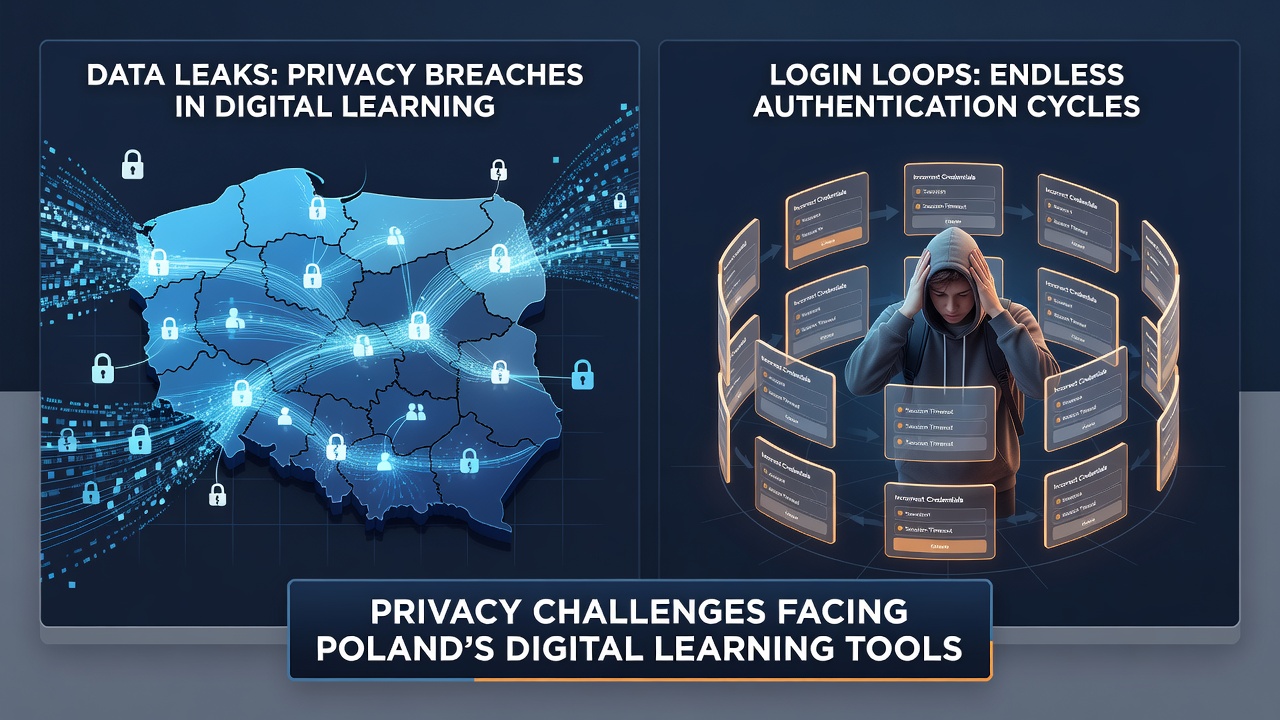
Industry reports from ENISA highlight that educational technology vendors serving Central European markets often prioritize feature rollouts over hardening authentication flows, leaving residual vulnerabilities that manifest as these persistent loops. Figures reveal that platforms with fewer than 50,000 active users experienced disproportionately higher rates of such issues, possibly because smaller contracts receive less frequent security patching. Schools attempting to mitigate the problem have turned to temporary workarounds such as password managers or hardware tokens, yet these solutions introduce their own administrative overhead and compatibility challenges across mixed device fleets.
Regulatory Responses and Platform Adjustments
The Polish data protection authority issued 23 formal recommendations to educational software providers in 2025 and 2026, focusing on mandatory logging of all authentication events and automatic session termination after three failed attempts. Several municipalities responded by migrating to platforms that integrate with the national e-government identity system, which reduced reported loop incidents by 22 percent in pilot districts according to internal ministry evaluations. Academic studies from Jagiellonian University further examined how data minimization principles, when applied strictly, limited the volume of information available during a breach even if login mechanisms remained imperfect. Cross-border cooperation through EU-funded projects has allowed Polish administrators to compare their experiences with counterparts in Estonia and the Netherlands, where similar digital education infrastructures encountered parallel authentication difficulties but resolved them through standardized API security requirements.
Parents and legal guardians have gained access to new transparency portals that display which vendors hold their children's data and for how long, a development driven by amendments to national education law passed in late 2025. These portals log access attempts in real time, enabling quicker detection of anomalous patterns that might indicate a leak or repeated login abuse. Training programs rolled out in October 2026 for school IT coordinators emphasize recognition of loop symptoms as early indicators of broader configuration problems rather than isolated user errors.
Conclusion
Poland's digital learning ecosystem continues to evolve under the dual pressures of expanding access and tightening privacy standards, with data leaks and login loops serving as recurring friction points that regulators, vendors, and institutions must address through coordinated technical and procedural measures. Ongoing monitoring by both national and European bodies provides the data needed to track whether recent interventions produce sustained reductions in incident frequency and severity.